How Do You Become a Certified Arborist in 7 Essential Steps?
To become a certified arborist, you’ll first need at least three years of relevant experience and possibly some formal education. During this time, you’ll gain hands-on training in pruning, climbing, safety, and pest diagnosis while logging 5,400 hours.
Next, it’s time to prepare using ISA study guides and online quizzes. After you feel ready, apply and pay the exam fee.
Once you pass, keep your certification active by earning continuing education credits every three years.
Stick to these steps, and you’ll discover detailed guidance at each stage.
Key Takeaways
- Gain at least 3 years of full-time arboriculture experience. This should include hands-on skills like pruning, climbing, and using equipment.
- Study core topics such as tree biology, pruning techniques, pest diagnosis, and safety. You can use ISA guides and online resources to help you learn.
- Document your education and verified work experience. This is important to meet the ISA certification eligibility requirements.
- Apply online through the ISA website. Be ready to pay the exam fee and schedule your certification exam, which you can take either in-person or virtually.
- Maintain your certification by earning 30 Continuing Education Units (CEUs) every three years. You can do this through courses and professional development activities.
What Does an ISA Certified Arborist Do?
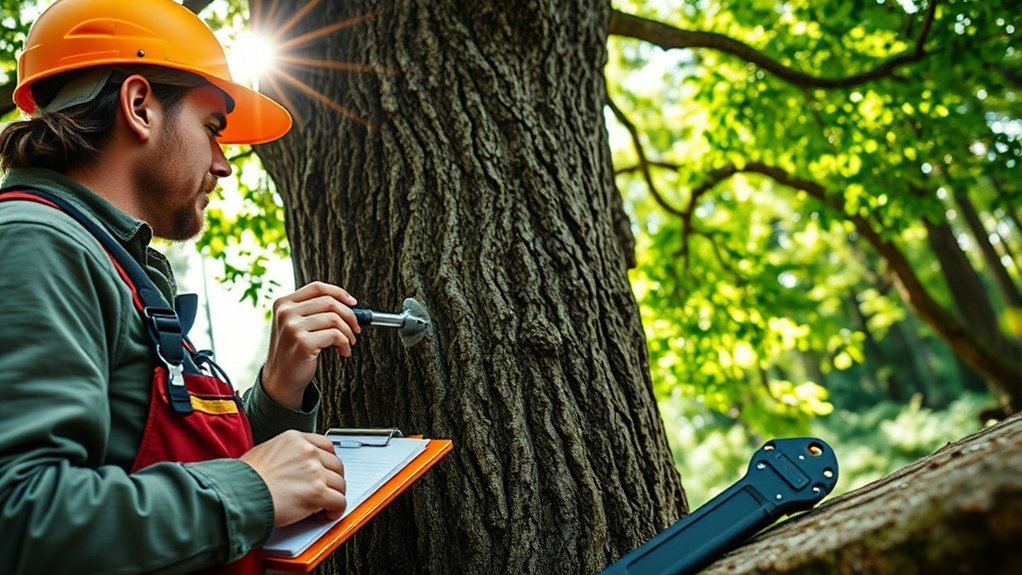
What exactly does an ISA Certified Arborist do? When you hire one, you’re getting a professional trained in arboriculture, dedicated to expert tree care.
An ISA Certified Arborist applies scientific principles and best management practices to maintain tree health and safety. They perform essential tasks like pruning, diagnosing tree health issues, and recommending treatments to extend a tree’s life.
You’ll also find them evaluating soil and site conditions to create tailored planting, fertilization, and pest management plans. Beyond care, they inspect trees for risks and structural stability, advising you on safety and preservation strategies.
Importantly, every ISA Certified Arborist follows a strict Code of Ethics, ensuring professionalism and integrity in all their work. This certification guarantees they meet high standards, so when you choose an ISA Certified Arborist, you’re trusting a knowledgeable expert committed to responsible tree care.
Meet ISA Certified Arborist Education and Experience Requirements
Although becoming an ISA Certified Arborist requires passing a rigorous exam, you’ll first need to meet specific education and experience criteria to qualify. These requirements guarantee you have a solid foundation in arboriculture before pursuing certification.
To meet the ISA Certified Arborist certification requirements, focus on these key areas:
- Experience: You typically need at least three years of relevant full-time experience in arboriculture. This hands-on work is vital to build practical skills.
- Education: Formal education, such as college courses related to arboriculture, can sometimes count toward the experience requirement, enhancing your knowledge base.
- Documentation: You must document your work experience, verified by employers or supervisors, to prove eligibility for the certification exam.
Meeting these requirements guarantees you’re well-prepared and qualified to take the certification exam confidently, setting the stage for a successful career in arboriculture.
Gain On-the-Job Training and Essential Safety Skills for Certification
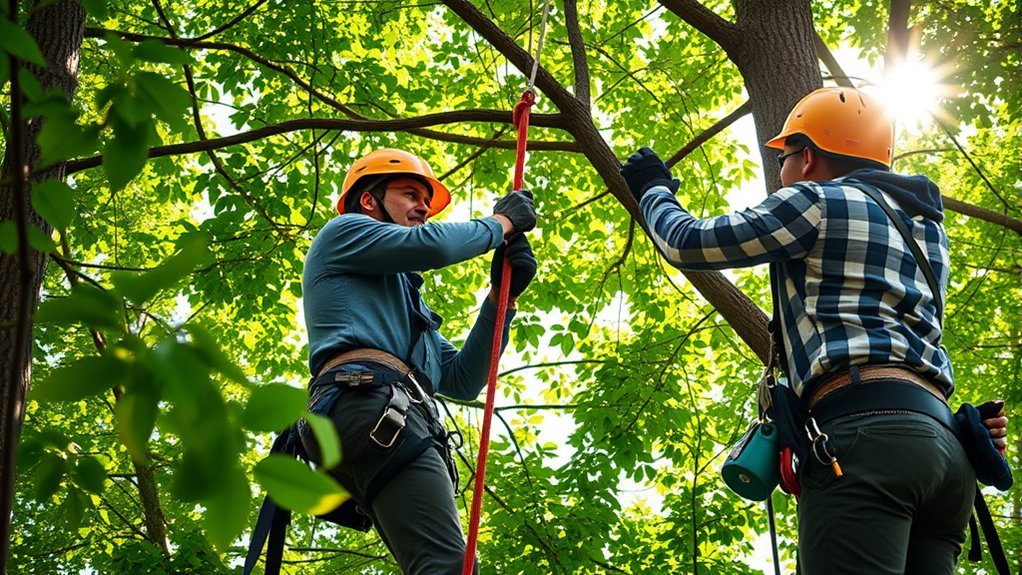
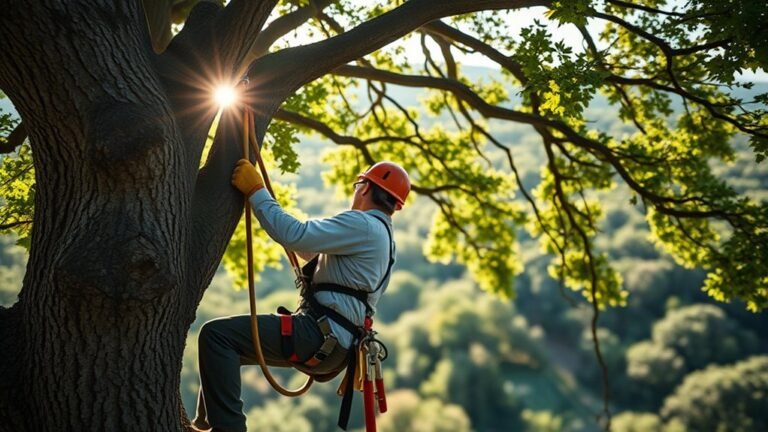
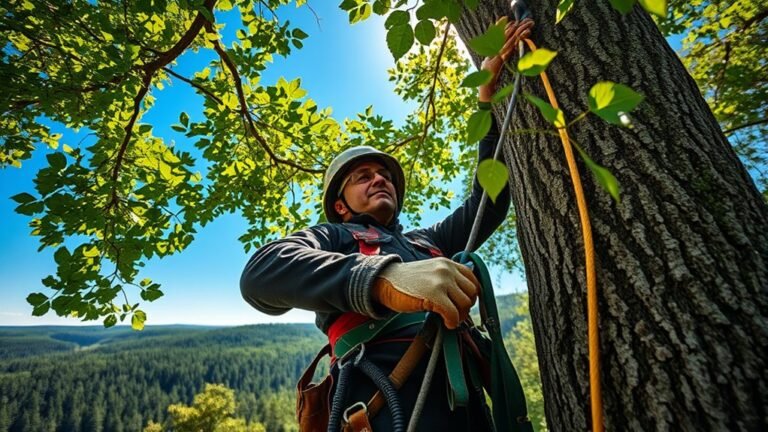
After meeting the education and experience requirements, your next step is gaining hands-on training that builds your practical skills and safety knowledge. You’ll need to accumulate about 5,400 hours of on-the-job training in arboriculture, focusing on climbing, pruning, and operating equipment safely.
Developing strong safety skills is essential; make sure you learn and consistently apply OSHA and ANSI standards to protect yourself and your coworkers.
Accurately documenting your experience is vital for meeting certification requirements. Keep detailed records of your work hours and responsibilities to verify your practical training during the application process.
Seeking mentorship from experienced arborists can accelerate your learning by exposing you to best practices in tree care and safety procedures. This combination of practical experience, safety skills, and thorough experience documentation lays a solid foundation for your certification journey.
Prepare for the ISA Certified Arborist Exam With Recommended Study Materials
Since preparing thoroughly is key to passing the ISA Certified Arborist Exam, you’ll want to rely on the ISA Certified Arborist Study Guide and recommended handbooks as your primary resources. These materials cover essential terminology and concepts, which make up about 80% of the exam content.
For effective exam preparation, consider these recommended resources:
- Use the ISA Online Learning Center for a self-paced training series featuring quizzes, multimedia, and interactive exercises. It’s a great way to learn at your own pace and really absorb the material.
- Practice with over 750 quiz questions available online to simulate exam conditions and test your knowledge. This will help you get comfortable with the format and identify areas where you might need more review.
- Join study groups or forums to exchange tips and clarify complex topics with fellow candidates. Studying with others can keep you motivated and provide new insights you might not get on your own.
Apply for the ISA Certified Arborist Exam: Step-by-Step Guide
First, you’ll need to create an account on the ISA website to access the certification application. Gather your work experience and education documents to complete the online form accurately.
Once you submit your application and pay the fee, you can schedule your exam date and location. It’s pretty straightforward, and having everything ready beforehand makes the process smoother.
Account Creation Process
Wondering how to kick off your journey to becoming a Certified Arborist? It all starts with the account creation process on the ISA website.
Here’s what you need to do: Begin with account registration by visiting the official ISA website and filling out the online application, providing your personal and professional information.
Next, submit the application along with any required documentation such as work experience or education. Then, pay the exam fee securely online.
After that, just wait for application approval. Once approved, you’ll receive confirmation and instructions to proceed with exam scheduling. Easy, right?
Application Submission Steps
Once your ISA account is set up and your initial application is ready, the next step is submitting all necessary documents and fees to guarantee your Certified Arborist exam. First, gather documentation that verifies your work experience, like employer letters or project records.
Make sure to review the exam eligibility requirements carefully to confirm you meet all the criteria. Then, complete your application by paying the applicable exam fee.
Before you submit, double-check all the details to avoid any mistakes. You can send the entire package through the ISA’s online submission portal or by uploading a PDF.
After you submit, you’ll wait for ISA’s approval to proceed. Once approved, you can schedule your exam at an approved testing center or opt for virtual testing. This moves you one step closer in the certification process.
Pass the ISA Certified Arborist Exam by Mastering Key Arboriculture Topics
To pass the ISA Certified Arborist Exam, you’ll need a solid grasp of core arboriculture topics like tree biology, soil management, and pruning. Focus on both studying the key materials and applying your skills through field practice, such as identifying tree species and proper pruning cuts.
Make sure to balance your study time across all exam sections. Safety practices are especially important since they carry significant weight. So, don’t skip over that part!
Core Arboriculture Knowledge
Although the ISA Certified Arborist Exam covers a broad range of topics, mastering core arboriculture knowledge is vital for passing. To meet the exam requirements and become a certified arborist, you’ll need to build a strong foundation in key subjects.
Focus on tree biology and soil management to understand plant health fundamentals. Then, get familiar with pruning techniques, diagnosis, and hazard recognition to apply practical skills. Also, safety practices are crucial to guarantee you work responsibly in varied environments.
About 80% of the exam tests core terminology and concepts, so grasping these areas is essential. Use the ISA Handbook, online Learning Center, and practice quizzes to reinforce your knowledge.
And don’t forget, gaining hands-on experience will help you confidently demonstrate thorough arboriculture expertise during the exam.
Exam Topic Coverage
What areas should you focus on to pass the ISA Certified Arborist exam? The exam topics cover 10 core areas including tree biology, soil management, pruning, diagnosis, and safety practices. You’ll need solid arboriculture knowledge and mastery of key concepts like pest identification and proper pruning cuts.
Safety makes up 15-20% of the test, so don’t overlook it. The exam combines multiple-choice questions with scenario-based practical assessment to test both theory and application.
Effective study preparation with guides, practice questions, and hands-on experience is essential. Make sure you get a good balance of all these to boost your confidence and skills.
| Exam Topics | Focus Areas | Importance (%) |
|---|---|---|
| Tree Biology | Understanding growth | 10 |
| Pruning | Proper cuts | 15 |
| Safety Practices | Safe work methods | 15-20 |
| Diagnosis | Pest & disease ID | 10 |
Practical Skill Application
Since mastering the core arboriculture topics is essential, you’ll want to focus on applying your knowledge practically. Developing practical skills through hands-on experience guarantees you’re ready for both the exam and real-world arboriculture.
Here’s how to build those skills effectively:
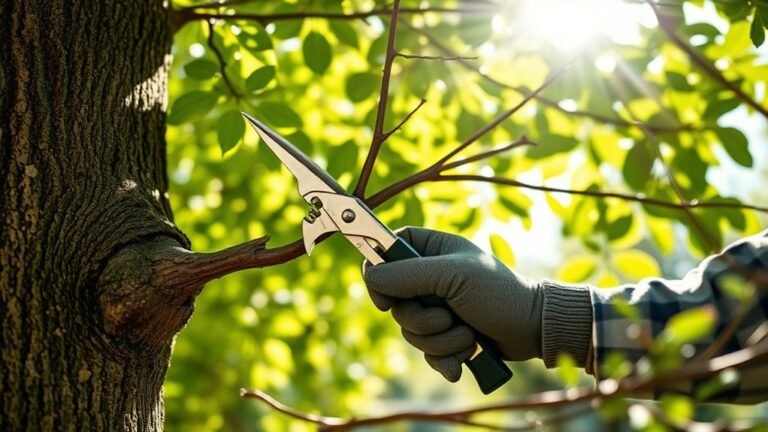
- Practice pruning techniques by performing proper cuts in controlled settings. This improves precision and helps you understand tree health better.
- Engage in field exercises to identify tree species, pests, and symptoms. Doing this sharpens your diagnostic skills under realistic conditions.
- Gain confidence in equipment use and safe climbing methods through simulations and supervised practice.
Maintain Your ISA Certified Arborist Credential Through Renewal and CEUs
To keep your ISA Certified Arborist credential active, you’ll need to renew it every three years by earning 30 Continuing Education Units (CEUs). These CEUs can be earned through webinars, conferences, or self-study activities like quizzes in Arborist News.
Tracking and documenting your CEUs is essential for a smooth renewal process. If you don’t accumulate the required CEUs within three years, you’ll have to retake the certification exam.
Maintaining your certification shows your commitment to professional development and guarantees you stay aligned with current industry standards. By actively pursuing renewal through CEUs, you keep your knowledge fresh and relevant — which benefits both your career and your clients.
Staying engaged with new research and best practices through these educational opportunities helps you remain a trusted expert in arboriculture. So, make sure to prioritize renewal and continuous learning to uphold your certification and advance your expertise.
Frequently Asked Questions
How Long Does It Take to Become a Certified Arborist?
It usually takes you about 3 to 5 years to become a certified arborist. You’ll need at least 3 years of relevant work experience before you can even take the exam.
Preparing for the test often takes several months to a year, depending on how much time you put into studying and gaining practical skills. After that, the certification process itself can be wrapped up in a few weeks to months.
How Hard Is It to Pass the Arborist Exam?
Passing the arborist exam can be pretty tough—you’ll need at least a 76% score to pass. It covers ten core areas, so you’ve got to know a lot, from tree biology to safety practices.
Without solid preparation, it’s easy to struggle. Using practice exams and study guides will help you get familiar with the format.
Plus, hands-on experience is key, especially for the safety and practical skills part. So, don’t just study—get out there and practice too!
What’s the Difference Between an Arborist and a Certified Arborist?
Oh, anyone can call themselves an arborist, but not everyone can brag about being certified.
When you’re a certified arborist, you’ve actually proven your knowledge by passing a tough exam, sticking to a strict code of ethics, and committing to ongoing education.
Do Arborists Make a Lot of Money?
Arborists can make a decent living, but don’t expect huge paychecks right away. Entry-level arborists usually start around $30,000 to $40,000 annually.
Once you get certified and gain experience, your salary can rise to $40,000 to $70,000. If you specialize or work in consulting or urban forestry, you might earn over $80,000.
Location and employer size also affect your earning potential, so it varies quite a bit. It really depends on where you work and what kind of jobs you take on.
Conclusion
So, you want to be an ISA Certified Arborist? Just breeze through years of study, master tree science, pass a tough exam, and keep updating your skills forever—no big deal, right?
If you enjoy endless learning and talking to trees professionally, this is your dream gig! But hey, once you’re certified, you’ll get to impress everyone with your knowledge and officially call yourself a tree whisperer.
Easy peasy!