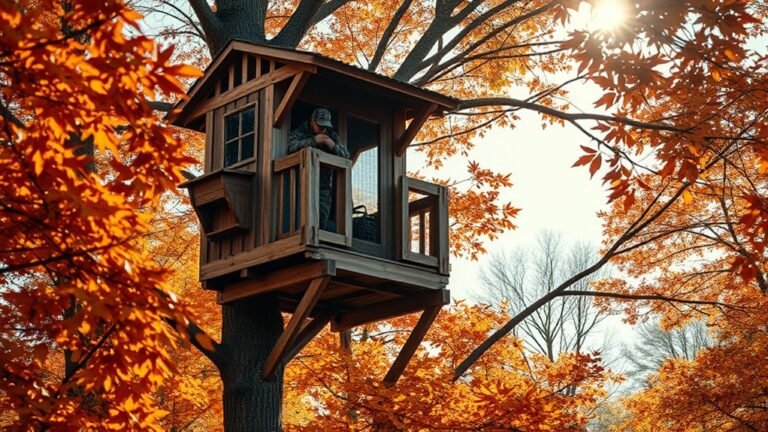

How to Hang a Deer Stand in 10 Easy Steps
To hang a deer stand safely, first pick a straight, healthy tree with a sturdy trunk and minimal dead branches. Gather safety gear like a full-body harness, quality ropes, and climbing tools.
Make sure to inspect your stand before you start. Then, attach safety lines and climbing aids securely.
Climb carefully while maintaining three points of contact.
Once up there, fasten the stand tightly with straps.
Check the stability of your stand and trim shooting lanes for clear shots.
Finally, finish with a thorough safety inspection.
Keep following for detailed tips to get it just right.
Key Takeaways
– Select a healthy, straight tree with at least a 12-inch diameter and a stable trunk for secure stand attachment.
You want to make sure the tree is solid enough to hold your weight safely.
– Wear a full-body safety harness connected to a solid anchor and maintain three points of contact while climbing.
Safety first! Always keep yourself secure when you’re going up.
– Attach the stand using snug, evenly tensioned straps without damaging the bark, securing all buckles tightly.
Make sure everything is tight but be gentle on the tree’s bark.
– Confirm the stand is level, stable, and securely fastened before trimming a clear shooting lane around it.
You don’t want any surprises once you’re up there, so double-check everything.
– Perform final checks on all straps, safety gear, and stand stability before climbing and during the hunting season.
Keep safety top of mind every time you use the stand, not just when you hang it.
Choose the Right Tree for Your Deer Stand

How do you pick the perfect tree for your deer stand? First, you want a straight, healthy tree with a trunk diameter of at least 12 inches to safely support your stand’s weight. Avoid dead or leaning trees since they’re unstable and could be dangerous.
Look around carefully for trees with a slight lean or perfectly straight trunks, as these allow straps and supports to attach more evenly and securely.
Also, check for any large dead branches or hollow sections—they can compromise the stand’s stability. You want a tree that’s solid all around.
Finally, consider trees with plenty of natural cover and branches at the right height. This helps you stay concealed while giving you safe shooting angles.
Picking the right tree is essential to making your deer stand safe and effective, so take the time to scout carefully and choose wisely.
Gather Essential Safety Gear: Harness, Ropes, and Tools

Once you’ve found the right tree to support your deer stand, the next step is to gather the proper safety gear to guarantee a secure setup. Always wear a full-body safety harness and attach it to a solid anchor point before climbing.
Use high-quality, rated ropes and straps designed specifically for tree stand installation to ensure stability. Prepare your tools—pruners, saws, screw-in steps—beforehand to avoid hazards during setup.
Don’t forget a sturdy lineman’s belt and life line system to maintain continuous safety contact with the tree during ascent and descent. Keep all gear organized and easily accessible to streamline your process and minimize risks.
Inspect and Prepare Your Tree Stand Before Installation

Before you install your deer stand, you should thoroughly inspect both the stand and the tree to guarantee a safe and secure setup. Start by carefully examining the tree to verify it’s straight, stable, and free from dead branches or decay.
Check the tree’s diameter to confirm it’s suitable for your type of tree stand—larger trees work best for hang-on stands, while smaller trees are ideal for ladder stands. Also, assess the tree’s lean and stability, steering clear of those that sway excessively or show signs of rot.
Clear away any dead or obstructive branches around your installation area to avoid interference and improve safety. Finally, evaluate the surrounding terrain and natural cover to confirm the location offers good concealment and a clear shooting lane.
Taking these steps ensures your tree stand and safety system will be reliable, helping you stay secure during your hunt. It’s always better to be safe and prepared!
Attach Safety Lines and Climbing Aids Securely
Although attaching safety lines and climbing aids might seem straightforward, doing it securely is crucial to prevent accidents. Start by fastening the safety line to the tree above your stand at a height that allows easy movement. Keep it taut but with some slack.
Use a locking Prussic knot or a similar device so the line slides smoothly as you ascend or descend. Attach the safety line firmly to your harness or lineman’s belt to stay connected at all times.
When installing climbing sticks, make sure each step is tightly screwed into the tree and stable before relying on it.
Remember these key points for secure attachment:
- Attach safety line above the stand with slight slack
- Use a locking Prussic knot for smooth rope movement
- Connect safety line to your lineman’s belt or harness
- Ensure climbing sticks are firmly screwed and stable
Double-check all attachments before you start climbing for maximum safety. It’s always better to be extra sure!
Practice Safe Climbing Techniques With Your Harness On
When you’re ready to climb your deer stand, always wear a full-body safety harness connected to a secure lifeline to protect yourself from falls. Before you start, practice climbing low on the tree with your safety harness on to build confidence and verify it fits and functions correctly.
Use climbing sticks securely attached to the tree to provide stable steps. As you ascend or descend, maintain three points of contact—two hands and one foot or two feet and one hand—to stay balanced and safe.
Don’t forget to use a lineman’s belt properly secured around the tree; it acts as a backup if your harness slips temporarily. Regularly inspect your safety harness for any signs of wear or damage before each climb, and replace it immediately if you find deterioration.
Practicing these techniques with your harness on will develop safe habits essential for a secure climb every time. It’s all about making safety second nature!
Position Your Deer Stand at the Proper Height and Angle
You’ll want to position your deer stand about 18 to 20 feet high for the best balance of concealment and safety.
Make sure the stand is angled slightly back to keep it stable and comfortable while you’re perched.
Adjust both height and angle based on your surroundings to get a clear view without alerting the deer.
Ideal Stand Height
How high should you hang your deer stand for the best results? The ideal stand height is generally between 15 to 20 feet above the ground. This height gives you good visibility while keeping you concealed from deer.
When setting your stand, focus on clear shooting lanes so you have an unobstructed view for ethical shots. It really helps to make sure you’re not blocked by branches or brush.
Keep these tips in mind for the ideal stand height:
- Position your stand slightly above deer paths to avoid detection. This way, you stay out of their line of sight.
- Aim for a level or slightly backward tilt for stability. You want to feel secure up there.
- Use a rangefinder to measure distances to key travel routes. Knowing exact distances can make a big difference.
- Adjust height based on terrain and natural cover. Every spot is different, so be ready to tweak it a bit.
Optimal Stand Angle
Getting the height right on your deer stand sets the foundation, but positioning the stand at the proper angle is just as vital for a successful hunt. You’ll want to angle your stand platform slightly back, about 10-15 degrees, to enhance stability and reduce sway when you move.
It’s essential to match the angle of the stand to the tree trunk’s natural curve—avoiding too steep or flat setups ensures both comfort and safety. Before securing the platform, use a leveling tool to make sure it’s perfectly horizontal, which gives you an ideal shooting angle.
Fasten the Stand Securely Using Quality Straps
You’ll want to choose durable, high-quality straps rated to hold more weight than your stand for extra safety. Make sure to pull the straps tight around the tree and support points, avoiding any slack or twists.
Double-check the tension and ratchet locks to keep everything securely in place. It’s always better to be safe than sorry when it comes to stability!
Choosing Durable Straps
Why settle for anything less than heavy-duty ratchet straps when securing your deer stand? Choosing durable straps is essential for a secure attachment that keeps you safe.
Look for ratchet straps rated for the combined weight of the stand and hunter. Always inspect straps for wear or damage before use, replacing any compromised ones immediately.
To guarantee stability, use multiple straps at various points around the tree. Remember these key tips:
- Select heavy-duty, weight-rated ratchet straps
- Wrap straps tightly around the tree and support points
- Avoid slack or twists to prevent shifting
- Double-check proper threading through buckles
Proper Strap Tightening
Once you’ve selected durable, heavy-duty ratchet straps, the next step is to fasten your deer stand securely to the tree. Proper strap tightening is vital to keep the stand stable and safe.
Start by tightening the ratchet straps gradually, making sure there’s even tension on all sides. This helps prevent any wobbling or shifting.
Use your hands or a strap tensioning tool to apply firm, consistent pressure. Just be careful not to damage the tree bark.
The straps should be snug enough to hold the stand firmly in place without cutting into the tree. After securing everything, double-check all the straps to make sure they stay tight before you climb.
Taking it slow and steady with strap tightening is key. This careful approach guarantees your deer stand stays reliable throughout the season.
Check Stand Stability and Adjust as Needed
Before settling into your deer stand, make sure the tree is stable by giving it a gentle shake to check for excessive sway. Ensuring stand stability is essential for safety and comfort.
If you notice any movement, adjust as needed by tightening the straps and repositioning the stand.
Here are key steps to maintain stability:
- Tighten all straps and buckles securely to prevent slippage.
- Confirm the stand sits level and at your desired height.
- Check that attachment points are properly positioned and secure.
- Reassess stability regularly, especially after strong winds or rain.
Taking the time to carefully check and adjust your stand will help avoid accidents and provide a reliable setup for your hunt. Don’t skip these checks; a stable stand means a safer, more enjoyable experience in the woods.
Trim Shooting Lanes Carefully for Clear Shots
Although trimming shooting lanes requires care, it’s essential for guaranteeing clear, unobstructed shots from your deer stand. To do this effectively, use pruning shears or a small hand saw to carefully trim branches that block your shooting lane without overdoing it.
Focus on lower branches within 10-15 feet of the stand, as these can interfere with your shot or make noise when you move. Your goal is to create a shooting lane just wide enough—about 8-12 inches—to allow a clean shot while maintaining natural cover for concealment.
Avoid trimming too many branches at once; instead, make small, precise cuts to reduce deer detection risk. Throughout the season, regularly check your shooting lanes and trim any new growth that could obstruct your view or cause noise.
This careful trimming ensures you have a clear, quiet path for accurate, ethical shots. It’s all about balancing visibility and staying hidden.
Perform a Final Safety Inspection Before Hunting
Since your safety depends on it, you’ll want to perform a final inspection of your deer stand before heading out. This final safety inspection guarantees everything is properly secured to the tree and functioning as it should, reducing the risk of accidents.
Focus on these key checks:
- Confirm all straps, buckles, and hardware are intact and securely fastened.
- Verify the stand is firmly secured to the tree with tight, undamaged straps or bolts and that it’s stable and level.
- Inspect safety harnesses, lifelines, and climbing gear for wear or damage and proper operation.
- Test all moving parts, like pulleys and hinges, for smooth, unobstructed movement.
Also, double-check that the platform and steps are solid and free from loose or protruding parts.
Taking these steps during your final safety inspection will help you hunt confidently and safely.
Frequently Asked Questions
Is 10 Feet High Enough for a Deer Stand?
Ten feet can be enough, but it’s usually on the low side. You’ll want to take into account your terrain and how much cover you have because deer might still spot or smell you at that height.
If you can, aim for 12 to 15 feet or higher—it helps with both safety and concealment. Ultimately, it depends on your specific hunting spot, but going higher usually gives you a better advantage.
How Do You Hang a Deer Correctly?
Did you know over 80% of hunting accidents happen due to improper stand setup? To hang your deer stand correctly, you’ll want to pick a sturdy, straight tree and use climbing sticks or a ladder safely.
Make sure to secure the stand with strong straps or screw-in steps, and double-check that it’s level and stable. Always wear a harness and safety line during the process to prevent falls and keep yourself safe.
Taking these steps really makes a difference—so don’t rush it! Safety first, every time you set up your stand.
What Is the 7 Day Deer Rule?
The 7 Day Deer Rule means you have to wait at least seven days before hunting deer in the same spot where one was recently taken. This rule helps keep deer populations healthy by preventing overhunting in one area.
If you ignore it, you could face fines or lose your hunting license. So, you’d better plan to move to new hunting locations after bagging a deer to follow the law.
What Not to Do in a Deer Stand?
Don’t dash dangerously or deal with damaged devices when you’re in a deer stand. You shouldn’t climb during crazy conditions like rain or wind, nor should you hang your stand on shaky or sickly trees.
Don’t skip securing your safety harness, and definitely don’t neglect checking your gear for wear. Rushing risks ruin, so take time to tether everything tightly.
Staying safe means staying smart and steady throughout your hunt. It’s all about being careful and thinking ahead.
Conclusion
Now that you know how to hang your deer stand safely, remember that nearly 80% of hunting-related falls happen because of improper setup or lack of safety gear.
By following these steps carefully, you’re not just preparing for a successful hunt—you’re protecting yourself.
Take your time, double-check everything, and enjoy the quiet patience that hunting demands.
Your safety is just as important as your shot, so stay secure and hunt smart.